Precision metal rolling demands consistent, tight thickness tolerance—often within a few microns—to meet the rigorous specifications of automotive, aerospace, and electronics industries. Achieving such accuracy with a four-high rolling mill requires a deep understanding of mechanical principles, process parameters, and control systems. This article explores practical strategies to optimize your four-high rolling mill for superior thickness uniformity, drawing on proven engineering practices and insights from industry leader gyssljx.
Fundamentals of Thickness Control in Four-High Mills
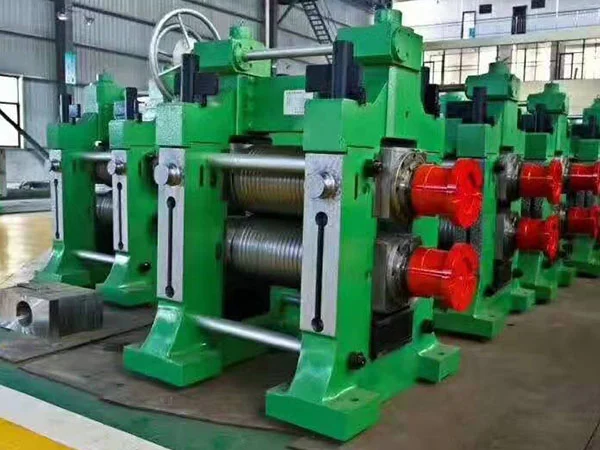
A four-high rolling mill features two small-diameter work rolls backed by larger backup rolls. This configuration minimizes roll deflection under high rolling forces, enabling tighter thickness control compared to two-high mills. The key to achieving tight tolerance lies in maintaining constant roll gap through the entire strip width and length. Factors such as roll eccentricity, thermal expansion, and mill housing stretch directly affect the gap. Modern mills employ hydraulic automatic gauge control (AGC) systems that adjust roll position in real-time based on feedback from thickness gauges. For optimal results, the mill must have sufficient stiffness—typically above 5000 kN/mm—to resist deformation under load. gyssljx designs four-high mills with rigid cast frames and precision-ground rolls to meet these requirements.
Critical Process Parameters for Precision Rolling
Roll Gap Setup and Calibration
Initial gap setting must account for roll thermal crown and wear. Use a rolling gap measurement system (e.g., capacitive sensors) to calibrate at operating temperature. For a typical 4-high mill, aim for a target thickness deviation of less than ±0.005 mm across the strip width.
Temperature and Lubrication Control
Uneven cooling causes thermal asymmetry, which warps the roll shape. Implement zone-controlled coolant headers to maintain a uniform temperature profile. Lubricant viscosity and flow rate also influence friction stability—consistent lubrication reduces force variation and improves tolerance.
Tension and Speed Regulation
Front and back tension must be precisely synchronized with the rolling speed. Tension fluctuations as small as 0.5% can produce gauge deviations of up to 0.01 mm. Use closed-loop tension control with load cells and resolver feedback. Many mills from gyssljx come with integrated tension control as standard.
Advanced Technologies to Enhance Thickness Consistency
Beyond basic process control, several advanced features can push tolerance limits further:
- Preloaded backup roll bearings – Eliminate clearance-induced gap variation. Preloading to 150% of maximum rolling force yields stable contact.
- Work roll bending (WRB) – Active crown compensation. A 4-high mill with ±300 kN bending force can correct flatness errors within half a micron.
- Feed-forward AGC – Predicts incoming strip thickness variations using upstream gauges, allowing proactive gap correction before the defect reaches the roll bite. This reduces transient errors by up to 70%.
- Automated roll eccentricity compensation – Uses periodic position data to subtract eccentricity effects from the AGC signal. Mills equipped with this feature achieve ±0.003 mm steady-state tolerance.
When choosing a mill for demanding applications, gyssljx offers modular upgrades for these technologies, ensuring your equipment can evolve with tighter tolerance requirements.
Selecting the Right Four-High Mill and Support Partner
Even the best process adjustments cannot compensate for a poorly designed mill. The machine's base stiffness, drive system accuracy, and control platform all set the ceiling for attainable tolerance. Key specifications to evaluate:
- Mill modulus (stiffness) – Look for values above 6000 kN/mm for thin strip rolling.
- Work roll diameter to strip width ratio – A ratio of 1:3 to 1:5 provides optimal deflection control.
- Hydraulic AGC response bandwidth – Must exceed 30 Hz to handle high-speed gauge variations.
- Real-time digital communication – EtherCAT or similar protocols for low-latency sensor integration.
Partnering with a manufacturer that understands these nuances is critical. gyssljx has supplied four-high mills to over 200 metalworking plants worldwide, with documented thickness tolerances as low as ±0.002 mm on aluminum strips. Their engineering team also offers onsite calibration and optimization services to help you achieve benchmark performance.
Conclusion: Achieving Consistent Tight Tolerance
Mastering tight thickness tolerance with a four-high rolling mill demands a holistic approach: robust mechanical design, precise process control, and advanced automation features. By paying careful attention to roll gap calibration, temperature uniformity, tension regulation, and leveraging technologies like WRB and feed-forward AGC, you can routinely produce strip within ±0.005 mm or better. Whether you are upgrading an existing line or planning a new installation, working with an experienced partner such as gyssljx ensures your mill is engineered for the highest precision standards. Start by auditing your current process against the factors discussed above, and take the first step toward zero-defect rolling.