In the metal processing industry, rolling mills are the cornerstone of producing steel, aluminum, and specialty alloys. Understanding the different types of rolling mills and their respective production processes is essential for optimizing efficiency, product quality, and operational reliability. This guide provides a detailed overview of the main rolling mill types and how they function.
Rolling Mill Types and Production Processes
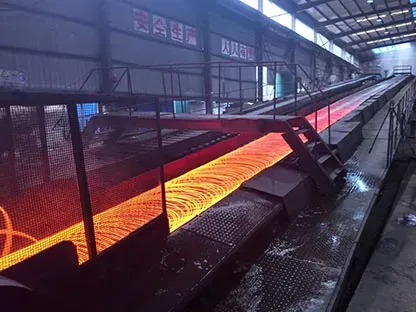
1. Two-High Rolling Mill (Reversing Mill)
Overview:
The two-high rolling mill is one of the simplest and most widely used rolling mills. It consists of two opposing rollers through which metal is passed, then reversed for subsequent passes.
Production Process:
Preheating: Metal slabs are heated to the required plasticity in a furnace.
Rolling Pass: The slab passes through the top and bottom rollers, reducing its thickness.
Reversal: The slab is pulled back for additional passes until the target thickness is achieved.
Cooling & Finishing: The rolled metal is cooled and cut to the required dimensions.
Applications:
Steel sheets, plates, and structural beams.
Ideal for small-batch or low-volume production.
Advantages:
Simple structure, easy maintenance.
Flexible for varying material sizes.
Limitations:
Lower throughput due to reversing steps.
Limited suitability for very thin sheets or high-volume production.
2. Three-High Rolling Mill
Overview:
The three-high mill features three rollers arranged vertically. This design allows the metal to pass through two rollers in one direction, then the next pair in the opposite direction, eliminating the need for reversal.
Production Process:
Heating: Slabs are preheated to ensure proper ductility.
First Pass: The top-middle roller pair performs the initial thickness reduction.
Second Pass: The middle-bottom roller pair further reduces the metal thickness.
Repeated Passes: The cycle continues until the desired thickness is reached.
Applications:
Long products such as rods, bars, and structural sections.
Advantages:
Continuous operation without reversing.
Higher efficiency than two-high mills.
Limitations:
Limited thickness reduction per pass compared to modern multi-high mills.
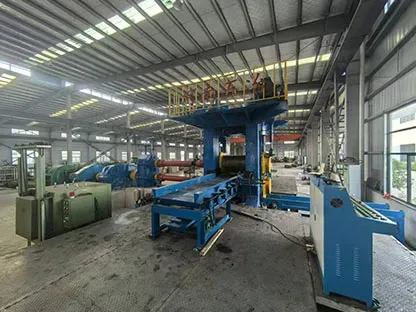
3. Four-High Rolling Mill
Overview:
Four-high mills feature two small-diameter working rollers and two larger backup rollers, providing the support needed for high-precision thin metal rolling.
Production Process:
Heating: Slabs or sheets are preheated (hot rolling) or rolled cold.
Rolling: Material passes between working rollers; backup rollers prevent bending and maintain uniform thickness.
Precision Control: Advanced systems adjust crown and tension to achieve exact specifications.
Finishing: Rolled sheets are cooled, coiled, or cut to size.
Applications:
Thin steel or aluminum sheets, strips, and foils requiring high surface quality.
Advantages:
High precision and excellent surface finish.
Suitable for both hot and cold rolling.
Limitations:
More complex machinery and higher maintenance costs.
4. Cluster Rolling Mill (Sendzimir / Z-Mill)
Overview:
Cluster mills use multiple small-diameter working rollers supported by several backup rollers, designed for extremely thin and high-precision metal products.
Production Process:
Cold or Hot Rolling: Depending on the material, the metal can be rolled hot or directly cold.
Cluster Rolling: The metal passes through the multi-roller cluster, achieving precise thickness control.
Final Treatment: Rolled foils or strips are coiled or sent for further processing.
Applications:
Stainless steel foils, aluminum foils, and specialty alloy strips.
Advantages:
Micron-level thickness accuracy.
Capable of rolling very hard metals and extremely thin sheets.
Limitations:
High equipment cost.
Complex maintenance and operation.
5. Hot vs. Cold Rolling Mills
Rolling mills can also be classified by temperature of operation, which directly affects metal properties:
Hot Rolling Mills
Operate above the recrystallization temperature.
Easier shaping, lower force required.
Produces plates, sheets, rails, and structural steel.
Surface finish is rough; dimensional tolerance is lower.
Cold Rolling Mills
Operate below the recrystallization temperature.
Produces thin sheets and strips with smooth surfaces and high dimensional accuracy.
Often follows hot rolling as a finishing step.
Requires higher rolling force and energy due to hardened metal.
6. Specialized Rolling Mills
Hot Strip Mills: Continuous hot rolling of steel coils, used for plates and strips.
Cold Strip Mills: Precision rolling for high-quality steel/aluminum strips.
Plate Mills: Focused on thick steel plates with high structural strength.
Bar and Section Mills: Produce rods, bars, rails, and structural profiles for construction and manufacturing.
Summary Table of Rolling Mill Types
Mill Type
|
Roller Setup
|
Product Type
|
Main Advantage
|
Key Limitation
|
Two-High
|
2
|
|
Simple, low cost
|
Slower, requires reversal
|
Three-High
|
3
|
Rods, bars, long products
|
Continuous rolling, faster
|
Moderate thickness reduction
|
Four-High
|
4
|
Thin sheets, strips
|
High precision, good surface
|
Complex, higher maintenance
|
Cluster (Sendzimir)
|
6–20+
|
Foils, specialty alloys
|
Extreme precision
|
Expensive, complex
|
Hot Rolling
|
Varies
|
Plates, rails, sheets
|
Easier shaping
|
Rough surface, lower tolerance
|
Cold Rolling
|
Varies
|
Strips, sheets, foils
|
High precision, smooth finish
|
Higher energy, harder metal
|
Conclusion
Understanding the type of rolling mill and its corresponding production process is essential for choosing the right equipment and optimizing operational efficiency. Whether producing thick plates, thin foils, or long bars, matching the mill type to product requirements ensures higher productivity, better surface quality, and cost-effective operations.